Guide
NARUTO Mythos TCG is a two player Naruto trading card game from Cicaboom, an Italian publisher. You play the Kage of your hidden village, send your ninja out on missions and win on the Mission Points they score. The first set, Konoha Shidō, launched across Europe, the United Kingdom and Turkey in March 2026 and a second edition of it followed in June. The second set, Shinobi Shiren, released worldwide on 4 September 2026 as the game began reaching stores in North America and beyond, and from the third set, Akatsuki, due in early 2027, every set is planned to release on one global schedule. HoloHoard carries the publisher's complete card list, edition by edition.
627 cards across 4 sets, catalogued and ready to track.
The first thing to know about this line is that a set can be printed more than once, and each printing is its own edition. Konoha Shidō came out in a 1st edition in March 2026 and in a 2nd edition from June 2026. The 2nd edition cards carry a distinct 2nd Edition stamp at the foot of the card, the packaging is different, the numbered Secret Variants are new, and the set gains two Legendary Gold cards where the 1st edition had one. Some cards were also reworded between the two printings: Hiruzen Sarutobi at 1/130 powers up another friendly Leaf Village character in the 1st edition and a friendly Leaf Village character in the 2nd. So HoloHoard applies the following rule: each edition is catalogued as its own set, with its own checklist, and a 1st edition card and its 2nd edition reprint are two different cards. The publisher has said Shinobi Shiren will get a second edition too. Open the Konoha Shidō 2nd Edition card list.
| Set | Edition | Released |
|---|---|---|
| Konoha Shidō | 1st edition | March 2026 |
| Konoha Shidō 2nd Edition | 2nd edition | June 2026 |
| Shinobi Shiren | 1st edition | September 2026 |
| Mythos Promo Cards | Promos and events | Ongoing |
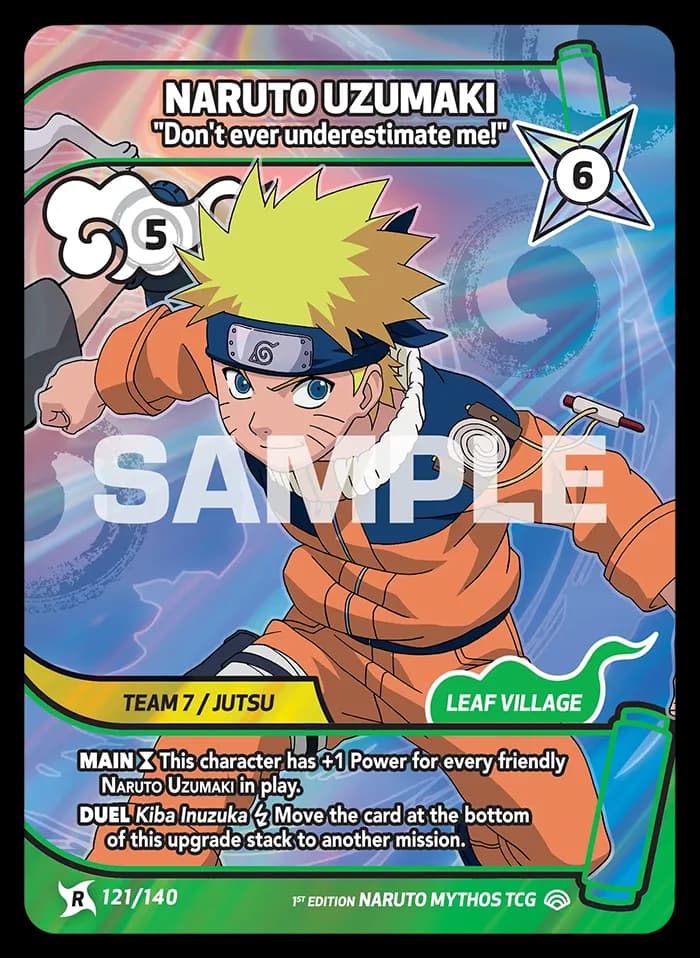
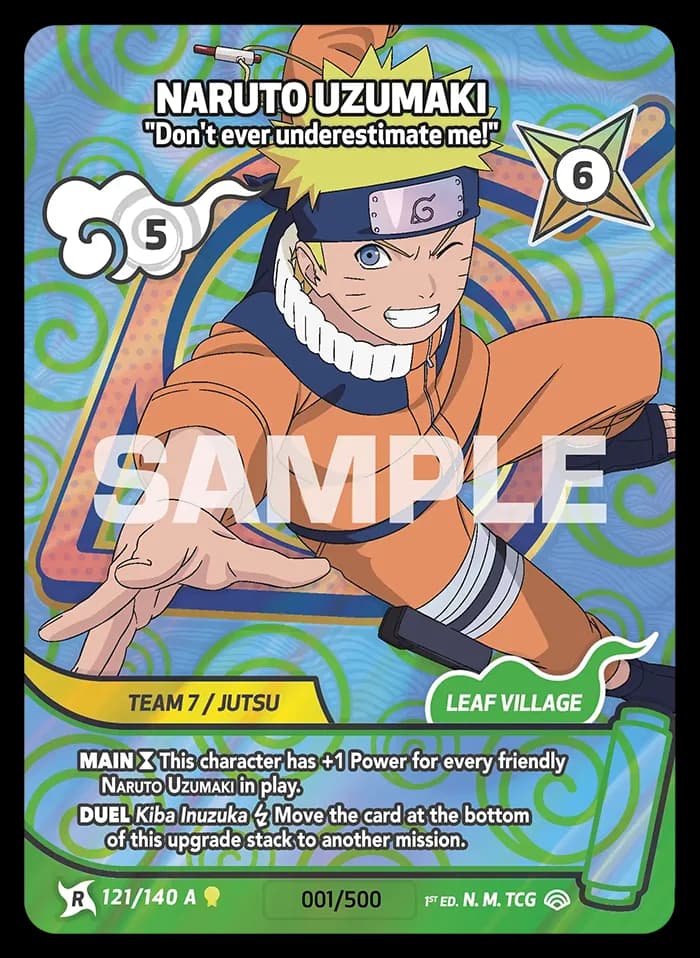
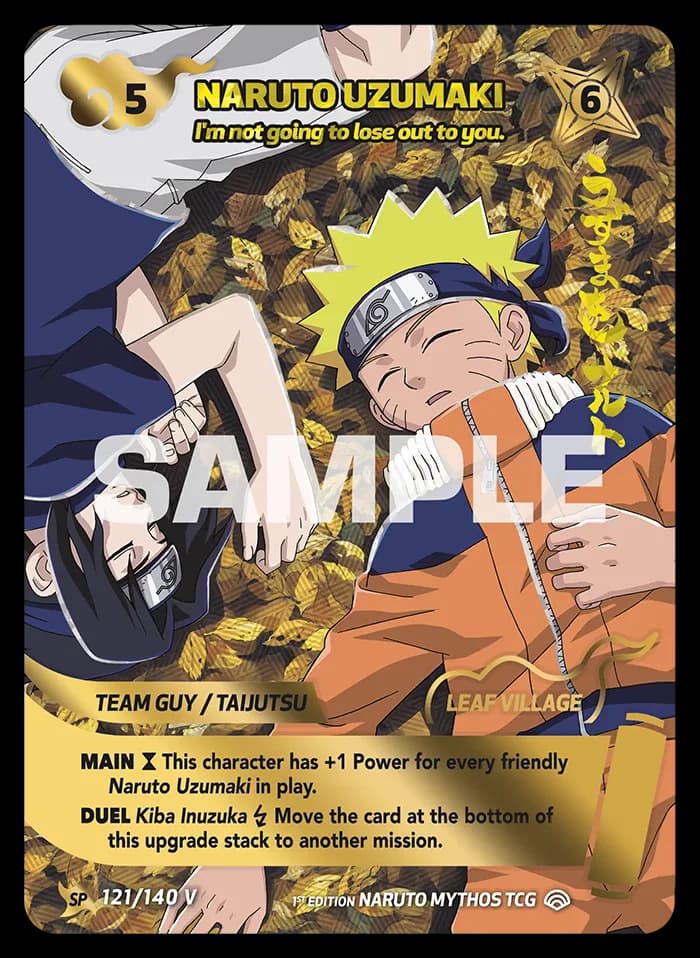
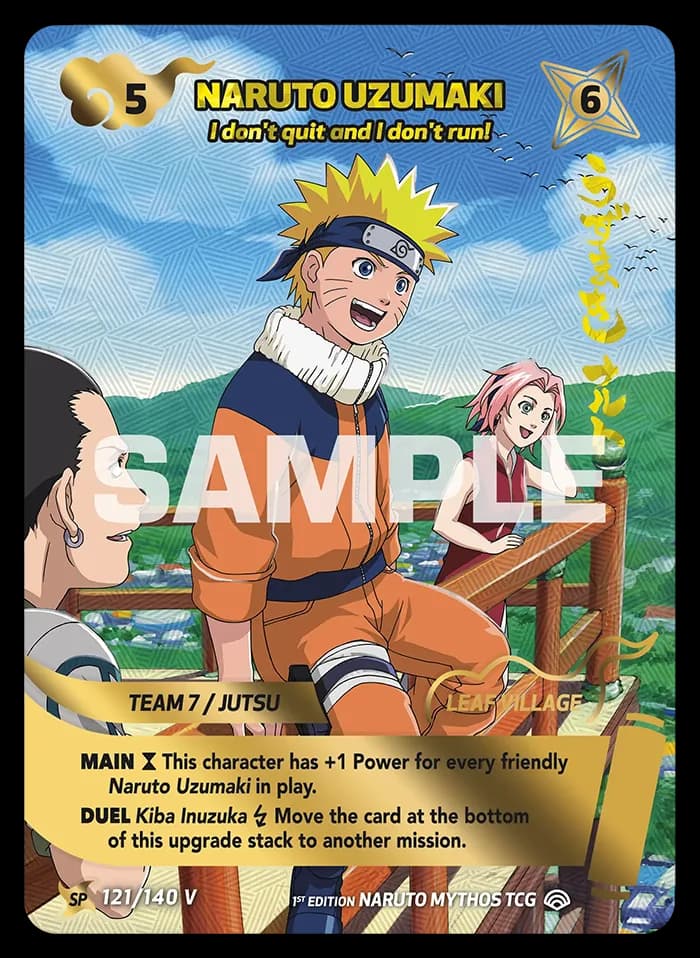
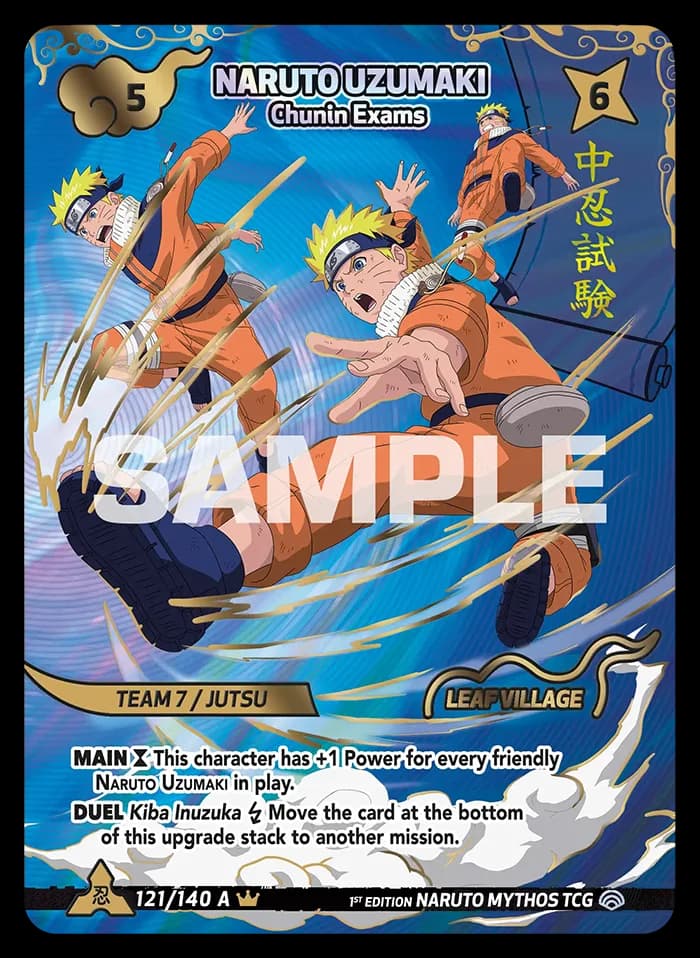
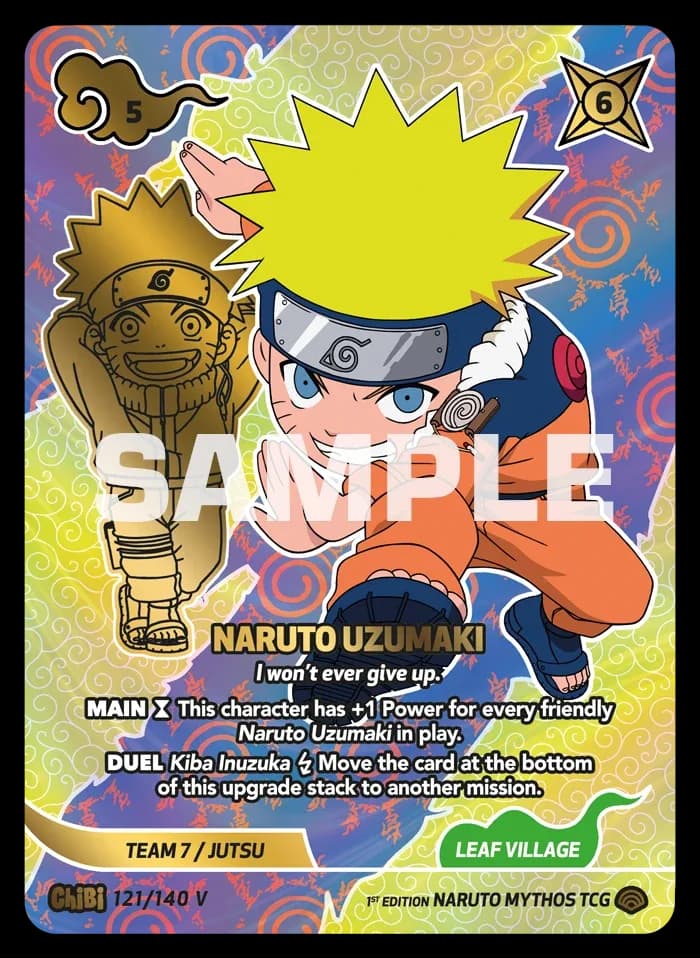
In a lot of trading card games a rarer version of a card is the same picture in a shinier finish. In NARUTO Mythos TCG a rarer version is usually a new piece of art. The Rare Art cards share a Rare's number with an A after it and a different illustration with micro-engraving. Shinobi Shiren goes further: Naruto Uzumaki at 121/140 exists as a Rare, a Rare Art, two different Specials, a Shinobi card and a Chibi, six pictures that share one number. The publisher's own gallery lists each of them separately, and HoloHoard does the same: every print with its own art is its own card, with the rarity in its title, so Naruto Uzumaki (RA) and Naruto Uzumaki (Shinobi) sit side by side on the set page. The one print that keeps the same illustration is the Secret Variant, which is why it appears as a variant on its Secret's card page rather than as a card of its own. See every print in Shinobi Shiren.
Each set is built on Commons and Uncommons, then Rares numbered to the end of the set, then Secrets numbered past it. Konoha Shidō prints every Common and Uncommon in three versions, Normal, FullArt and Holographic, and HoloHoard lists all three on each card page. Shinobi Shiren keeps the FullArt and Holographic versions for its characters and adds Attachments in standard and holographic. Above the Rares sit the chase cards, most of them individually numbered, and at the very top the Legendary Gold, printed with 22 karat gold foil. Open the Konoha Shidō card list.
| Rarity | Where it appears | What it is |
|---|---|---|
| Common and Uncommon | Every set | The base run, in Normal, FullArt and Holographic versions (Shinobi Shiren: FullArt and Holographic) |
| Rare | Every set | Holographic cards that join into continuous illustrations when laid side by side |
| Rare Art | Every set | A new illustration of a Rare's number with micro-engraving, printed with an A after the number |
| Special | Shinobi Shiren | A full art reworking of a Rare or Secret, printed with a V after the number |
| Shinobi | Shinobi Shiren | Chūnin Exams duels drawn in pairs, marked with a crown |
| Chibi | Shinobi Shiren | Characters redrawn in a playful SD style, found as box toppers and at events |
| POP | Shinobi Shiren | Individually serialised cards on lenticular holographic stock |
| Secret | Every set | Holographic and gold cards numbered past the end of the set |
| Secret Variant | Every set | A Secret's illustration recoloured with a serigraphic texture, individually numbered |
| Legendary | Every set | The Legendary Gold, in 22 karat gold foil, individually numbered |
| Mythos | Promos and events | Cards from special products, events and Organized Play, each with exclusive artwork |
| Mission | Every set | Widescreen cards with their own numbering |
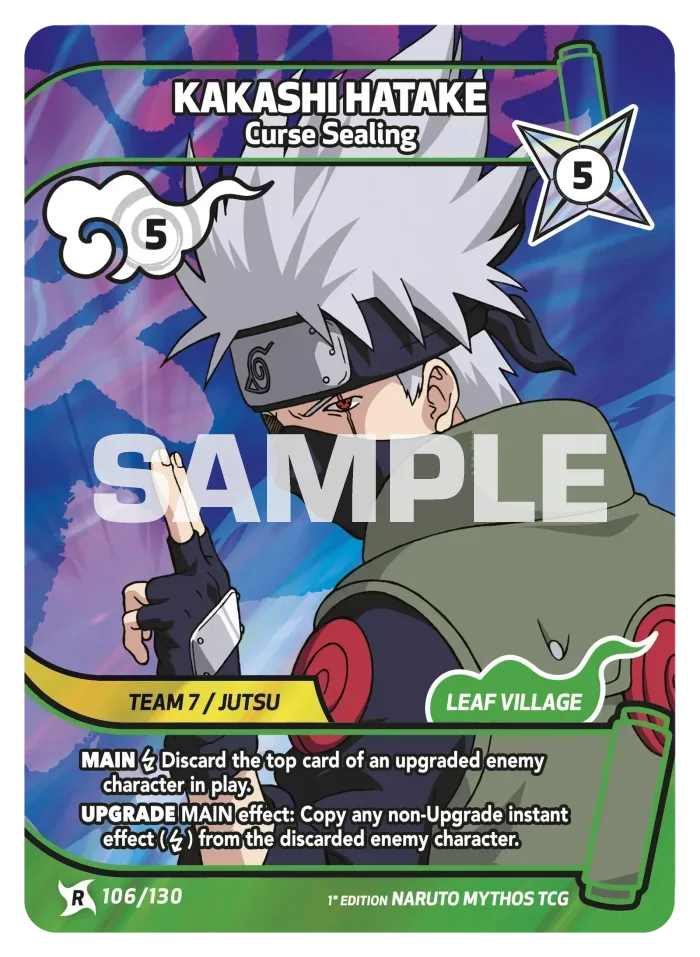
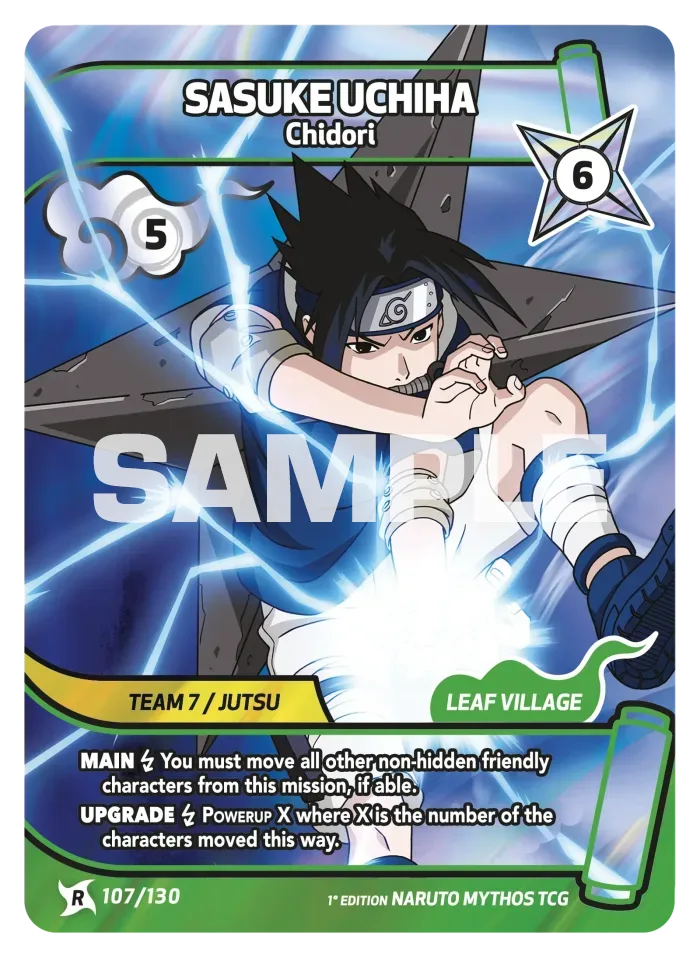
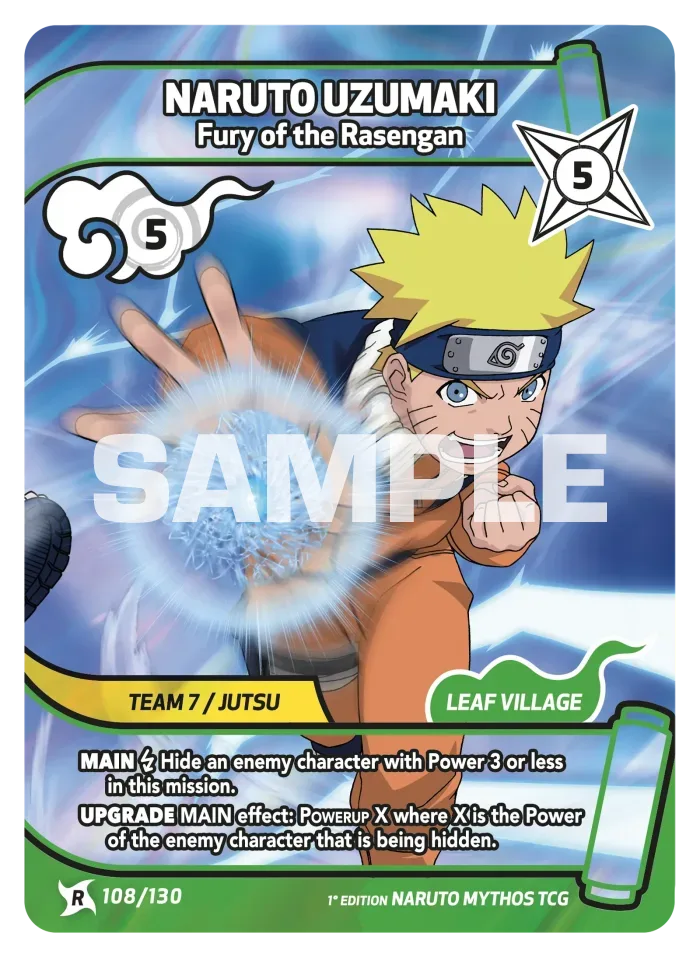
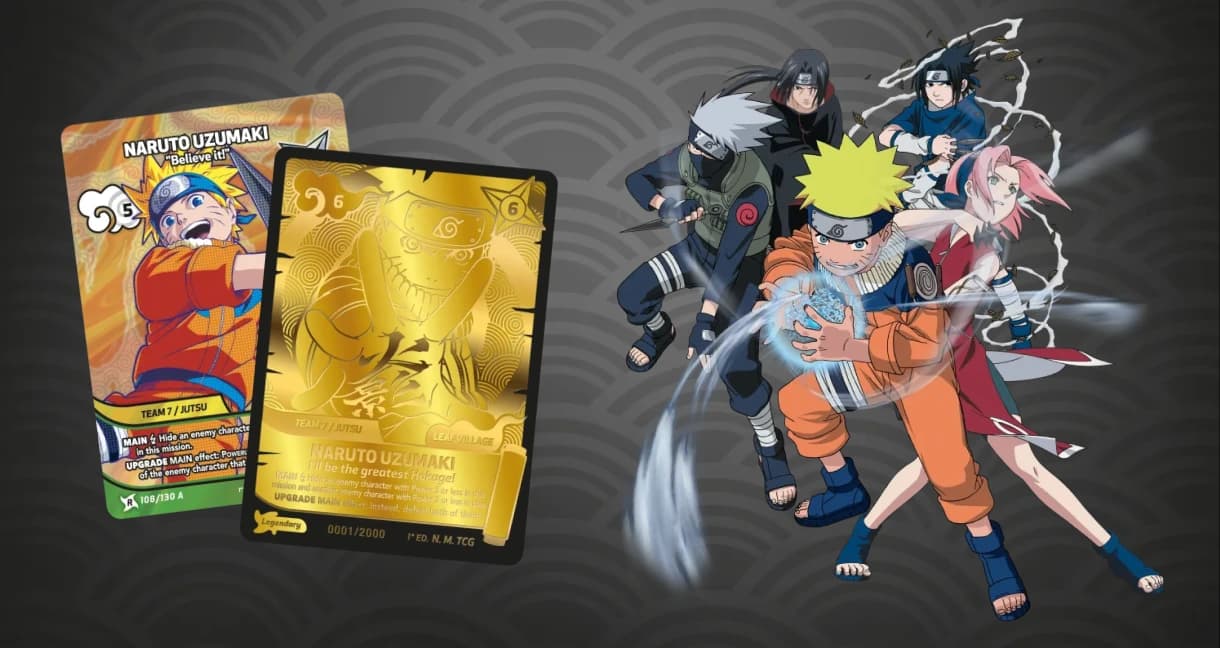
The Rares are where the line puts its storytelling. Laid side by side, groups of them form a single continuous illustration: the Konoha Shidō Rares make nine of these scenes and the Shinobi Shiren Rares make eleven. Shinobi Shiren adds the Shinobi rarity on top, cards drawn in pairs around the most famous duels of the Chūnin Exams, so that two cards placed together put the whole fight back on the table. The three shown here, Kakashi Hatake, Sasuke Uchiha and Naruto Uzumaki at 106 to 108 of Konoha Shidō, are one of those scenes. The set pages list the cards in number order, which is the order the scenes read in, so a binder page fills in the way the picture does.
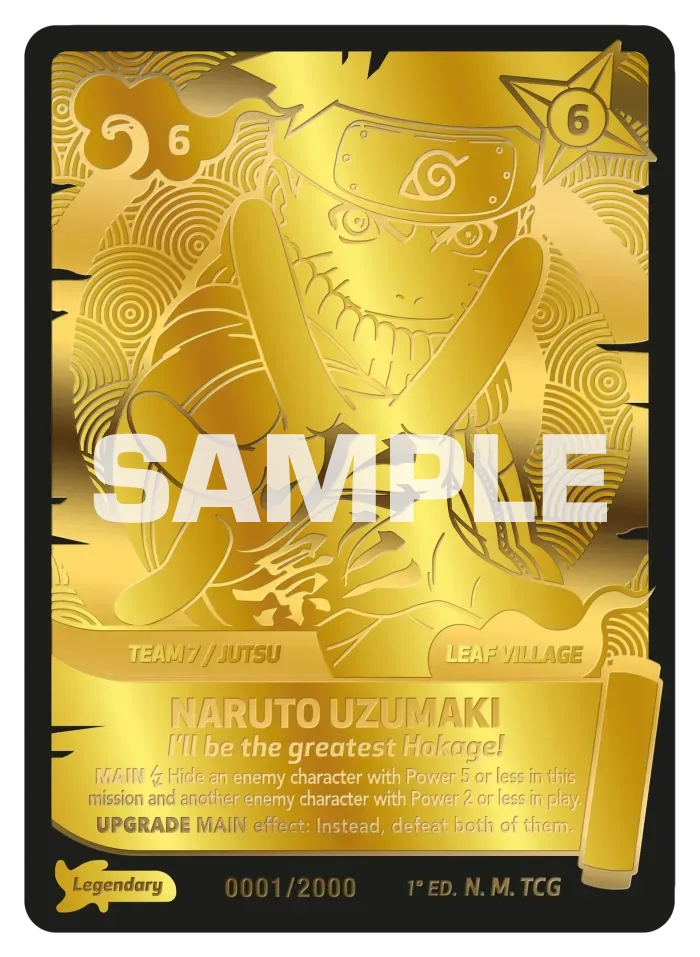
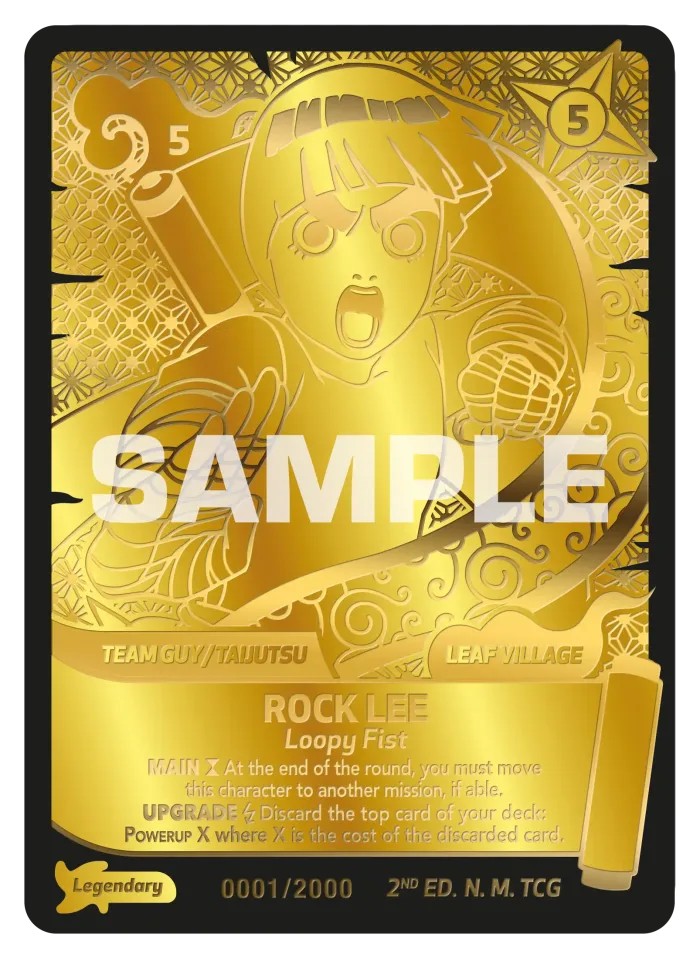
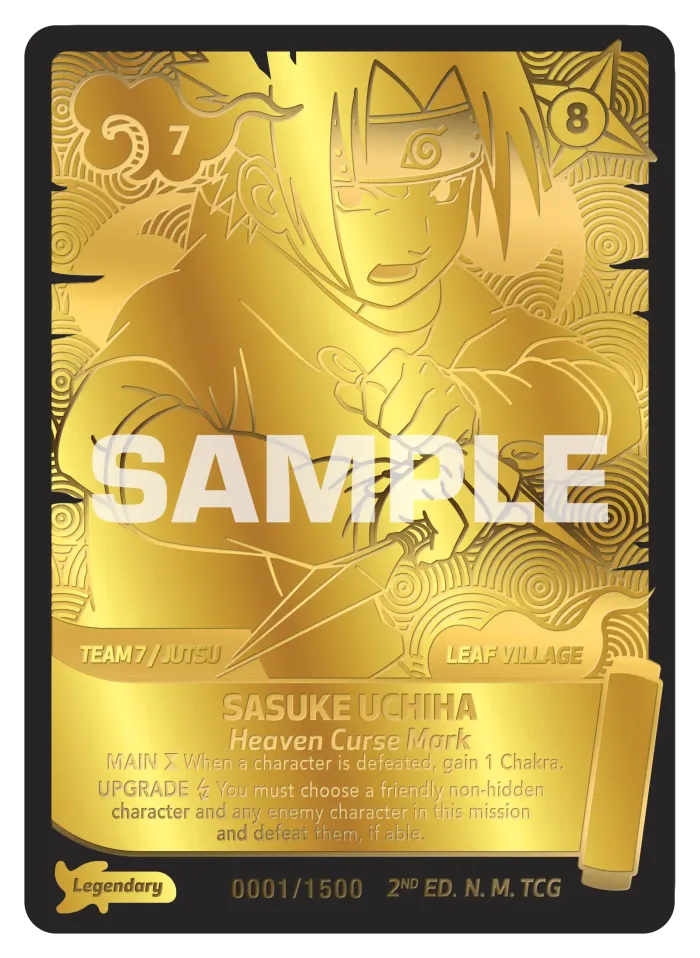
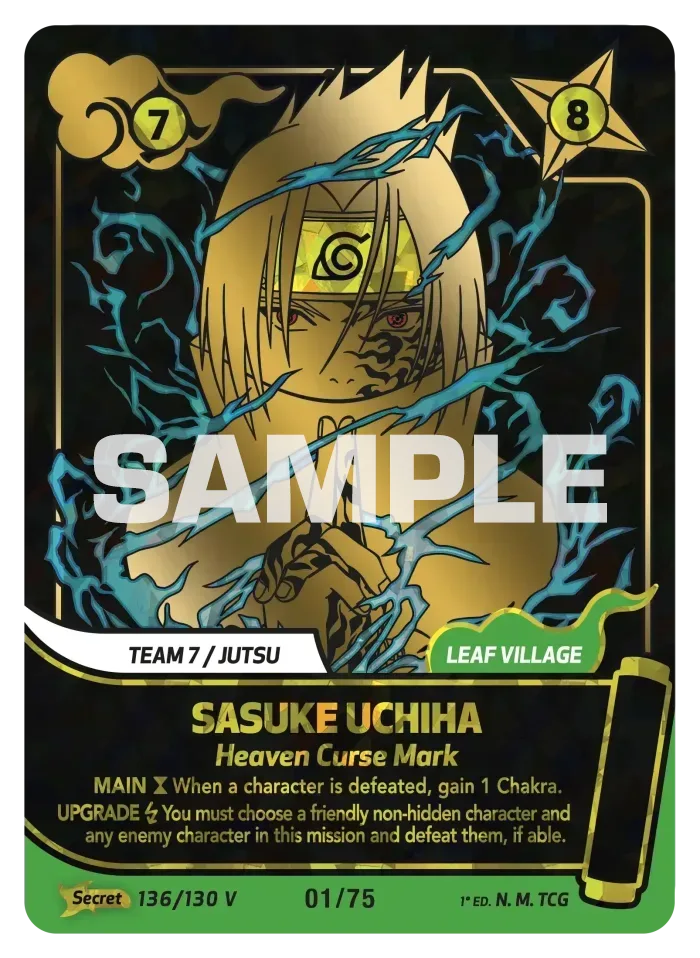
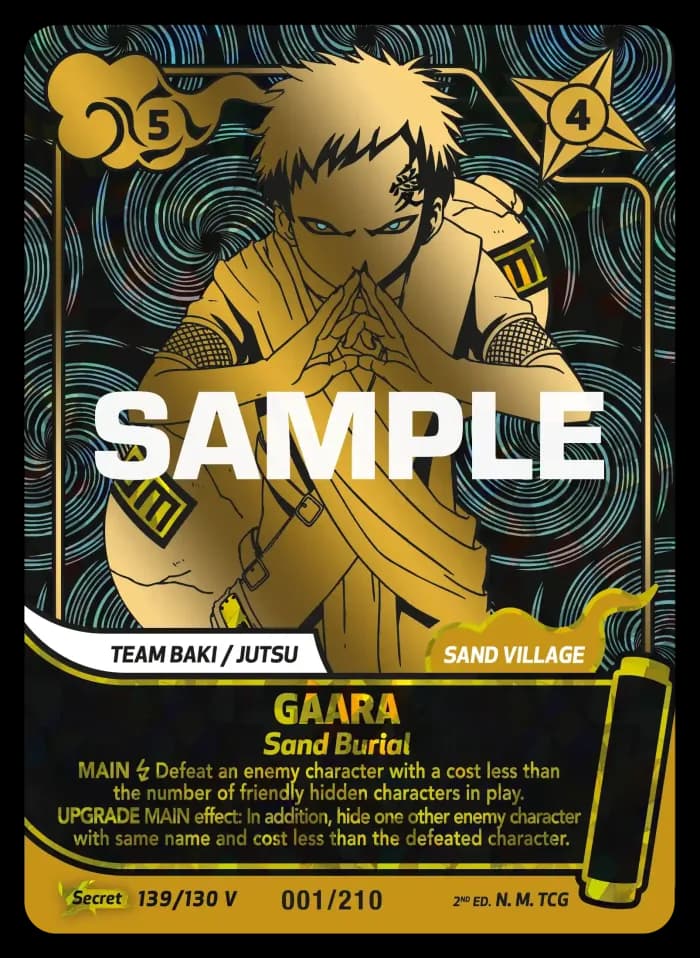
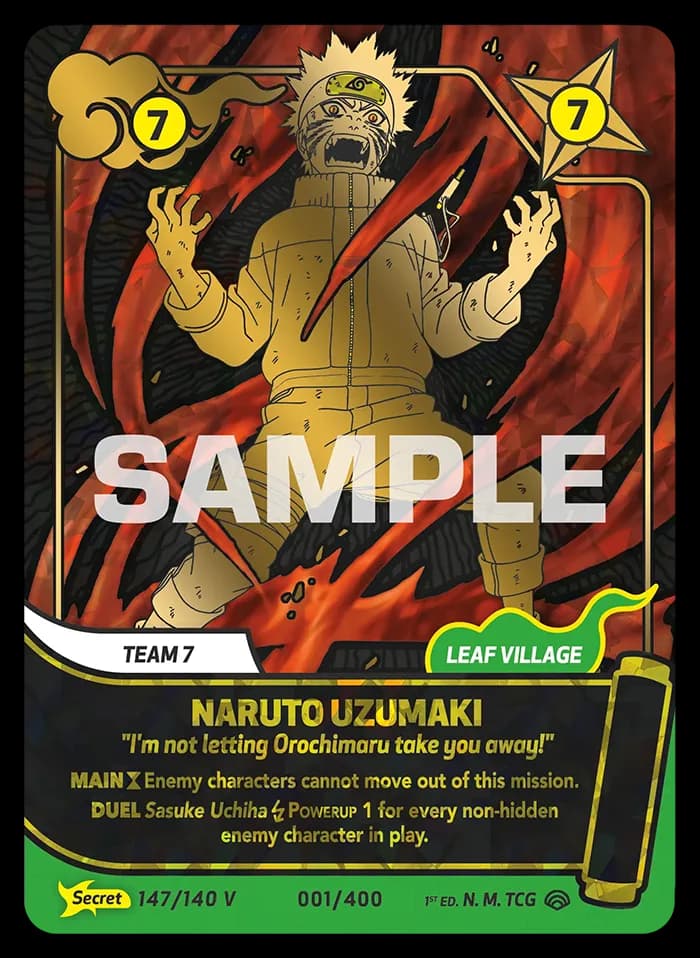
Every set has four Secret Variants, recoloured versions of four of its Secrets with a serigraphic texture, and each one is individually numbered. In the Konoha Shidō 1st edition they are numbered out of 75, in the 2nd edition out of 210, and in Shinobi Shiren out of 400. Shinobi Shiren also numbers some of its Rare Arts, out of 500, and every POP card, out of 300. The Legendary Gold is the top of each set, made with genuine 22 karat gold leaf from the Florentine goldbeater Giusto Manetti Battiloro and individually numbered. In the English edition, the 1st edition of Konoha Shidō has a single one, Naruto Uzumaki, numbered out of 2,000, and the 2nd edition two, Rock Lee numbered out of 2,000 and Sasuke Uchiha out of 1,500, and Shinobi Shiren's three are each numbered out of 1,500; the French edition prints fewer of each. When you add one of these to your collection you can record its exact serial number on the copy you own. See the Konoha Shidō Secrets.
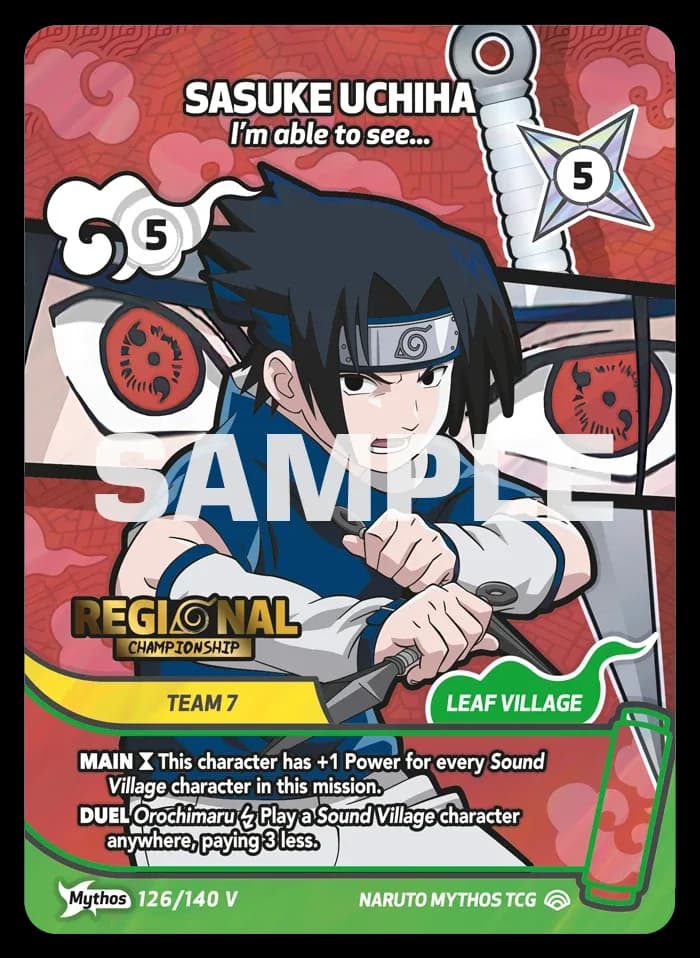
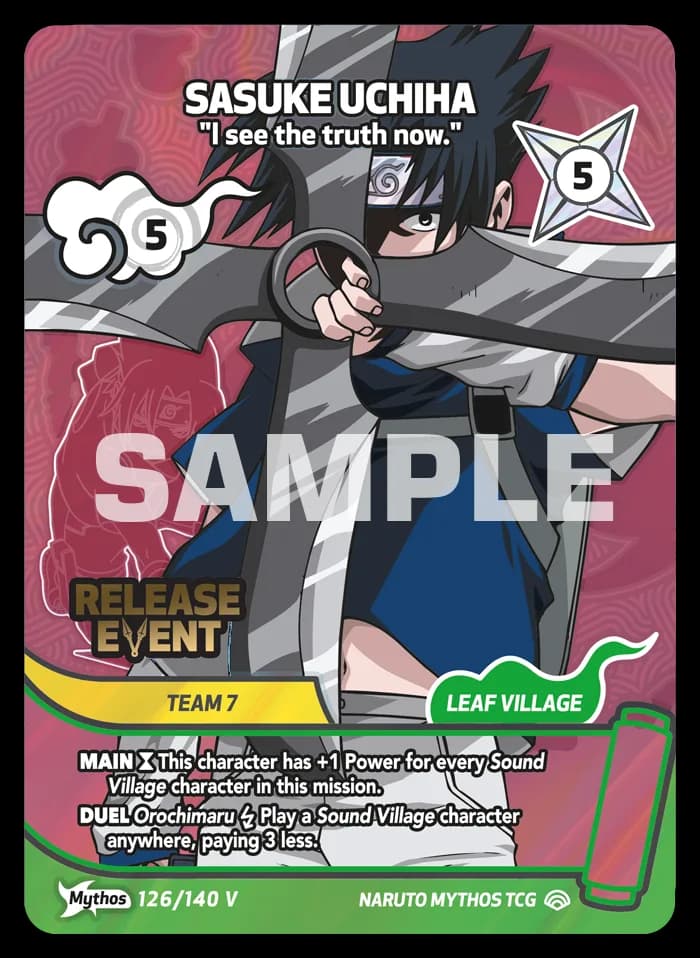
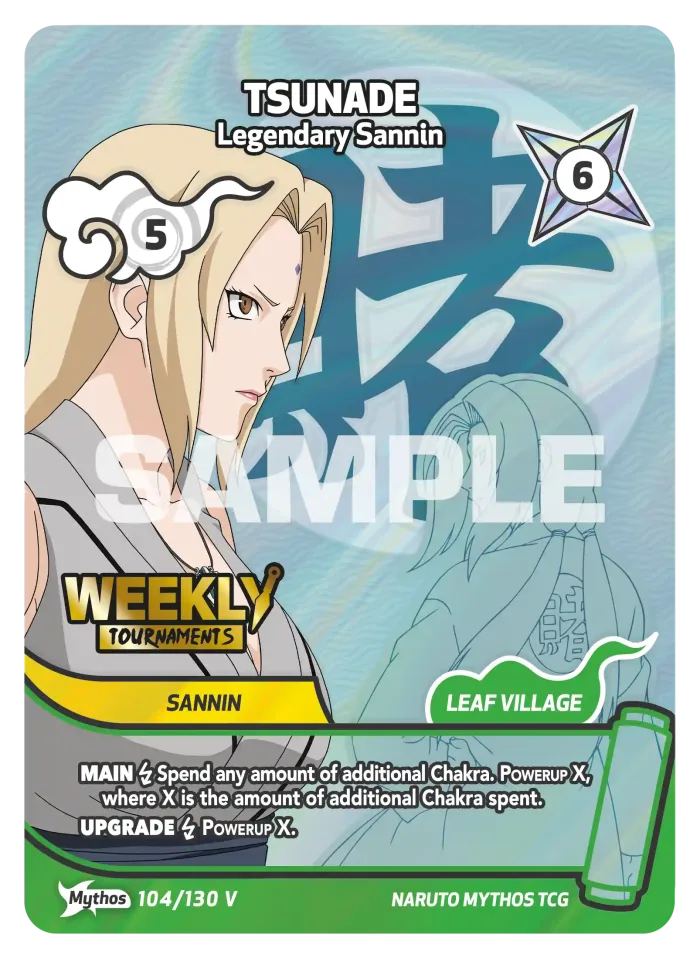
Mythos cards sit outside the booster collection. They come from Starter Packs, Team Sets and special packs, from fairs and launch events, and from Organized Play at weekly tournaments, store championships and regionals, and each carries artwork made for that card. Some are entirely new cards numbered past the set; others are Mythos versions of a card already in it and keep its number with a V. Many carry the stamp of the event they were handed out at, such as Weekly Tournaments, Store Championship, Regional Championship or Release Event, and two cards from different events can share a number while showing different art. HoloHoard keeps them together in one Mythos Promo Cards set, the way the publisher's own card gallery groups them, each as its own card keeping the number of the set it belongs to, with the event and how it was given out on the card page. Open the Mythos Promo Cards.
For those who go beyond collecting and play the game, here is what the printed values mean. A game runs over four Rounds, with a new Mission coming into play each Round, and the side with the most Power on a mission wins it and scores its Mission points. Characters are the ninja you assign to those missions: you pay their Chakra cost to play them face up, or one Chakra to play them hidden face down and reveal them later. A deck holds at least thirty cards, any number of a name but no more than two copies of one version, and each player brings three Missions that stay out of the deck. Shinobi Shiren adds Attachments, which are equipped to a Character or a Mission to enhance its effects. Every card page on HoloHoard shows these values under the publisher's own names.
| Printed value | What it means |
|---|---|
| Name | The character. Only one card of a name can be on your side of a mission |
| Version | The line under the name that tells two cards of the same character apart |
| Chakra cost | What it costs to play the card face up |
| Power | Added up on each mission to decide who wins it |
| Keywords | Groups such as Team 7, Jutsu or Sannin that other effects refer to |
| Faction | Leaf Village, Sand Village, Sound Village, Akatsuki or Independent |
| Rarity | Printed at the foot of the card with its number |
Every card in the game is already on HoloHoard, edition by edition: find it, tap it, say how many you have. Your collection counts each card on its own, so a 1st edition Hiruzen and a 2nd edition Hiruzen are two entries, and the FullArt and Holographic versions of a Common are recorded separately on the same card. Lists are for everything you are thinking about rather than holding: a want list for the Rares you need to finish a scene, a trade list for your spares, a sale list for the cards you want to part with. And because this is a game you play, you can build decks too, from the exact prints you own, and share the decklist with a read only link. Every set has a checklist you can print and fill in by hand if that is more your style.
Yes. HoloHoard tracks NARUTO Mythos TCG collections for free, with the publisher's full card list already built in, so you mark the cards you own rather than typing them in. A free account covers collection tracking, wishlists and set completion; a Premium tier adds deeper analytics and higher limits.
No. NARUTO Mythos TCG is Cicaboom's game, released in Europe, the United Kingdom and Turkey from March 2026, in which you send ninja out on Missions. The Naruto Card Game is a different game from Bandai, built around a Leader card. HoloHoard catalogues them as two separate games.
The 2nd edition reprints a set with a 2nd Edition stamp on every card, new packaging, its own numbered Secret Variants and an extra Legendary Gold card, and some cards were reworded. HoloHoard lists each edition as its own set, so a 1st edition card and its 2nd edition reprint are tracked as two cards.
Yes. A Rare Art, Special, Shinobi, Chibi or POP print carries its own illustration, so HoloHoard catalogues it as its own card with the rarity in its title. The Secret Variant is the exception: it shares its Secret's illustration, so it is a numbered variant on the Secret's card page.
Every set has its own page on HoloHoard with the full card list and a printable checklist: Konoha Shidō, Konoha Shidō 2nd Edition, Shinobi Shiren and the Mythos Promo Cards. The list and its grouping follow the publisher's own card gallery.
Yes. The HoloHoard app is a free download on Google Play for Android. On a line printed in editions it settles the question while the card is in your hand: check the edition mark at the foot of the NARUTO Mythos TCG card at a weekly tournament, and add it to the edition it belongs to. Same account as the web, so both editions stay in step everywhere. Store links are on the HoloHoard app page.
Start your collection, free
No account needed to browse. Create one to track and value your cards.