Guide
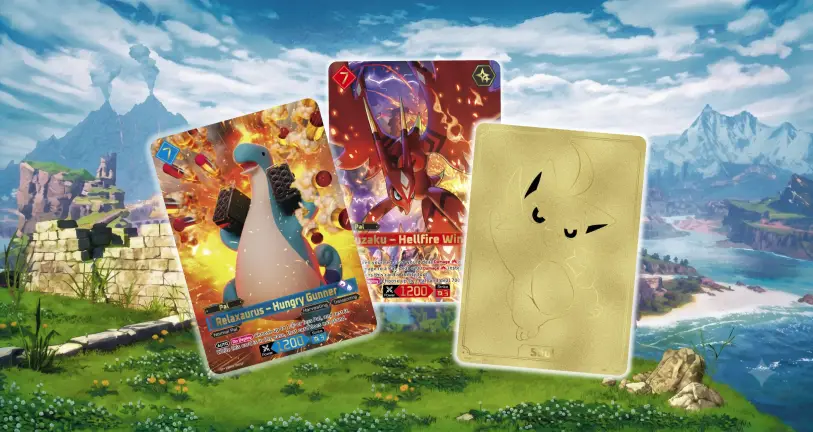
The Palworld Official Card Game brings Bushiroad's take on the survival crafting world to the table, with the Pals you already know leading the fight alongside the gear, structures and events they use. Collecting it is about the chases and about finishing sets: every Pal in a wave, the parallel art that sits alongside them, and the trial deck cards you can only get one way. HoloHoard already has the whole catalogue built, so you mark what you own instead of typing it in.
270 cards across 8 sets, catalogued and ready to track.
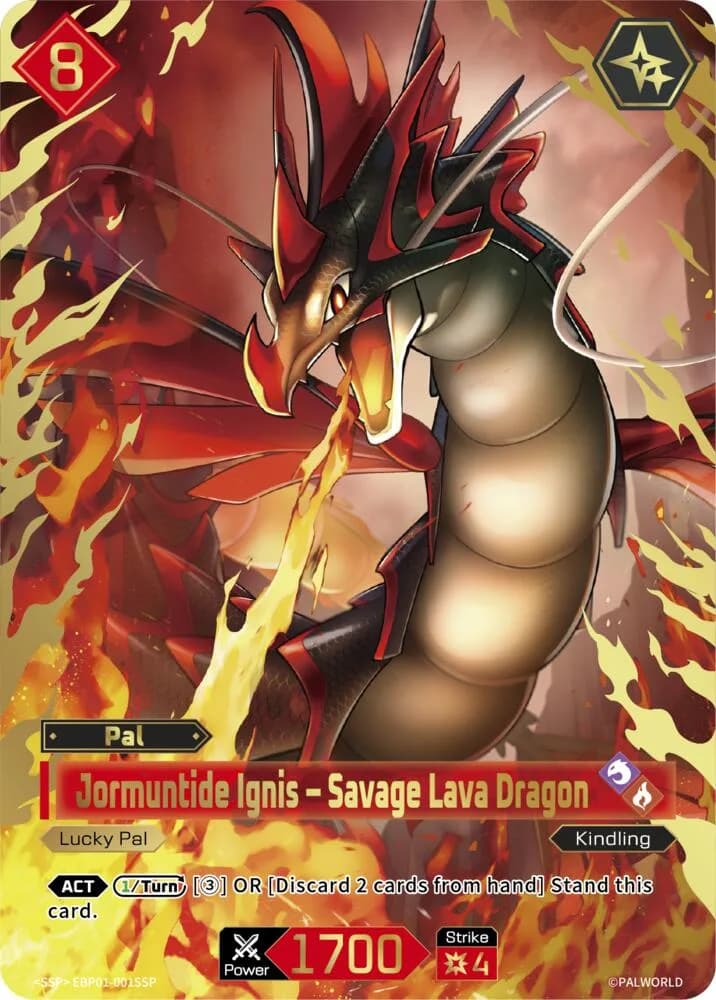
EBP01-001SSP
Jormuntide Ignis - Savage Lava Dragon (SSP)
Palworld Official Card Game · Foil
Est. Value $434.86
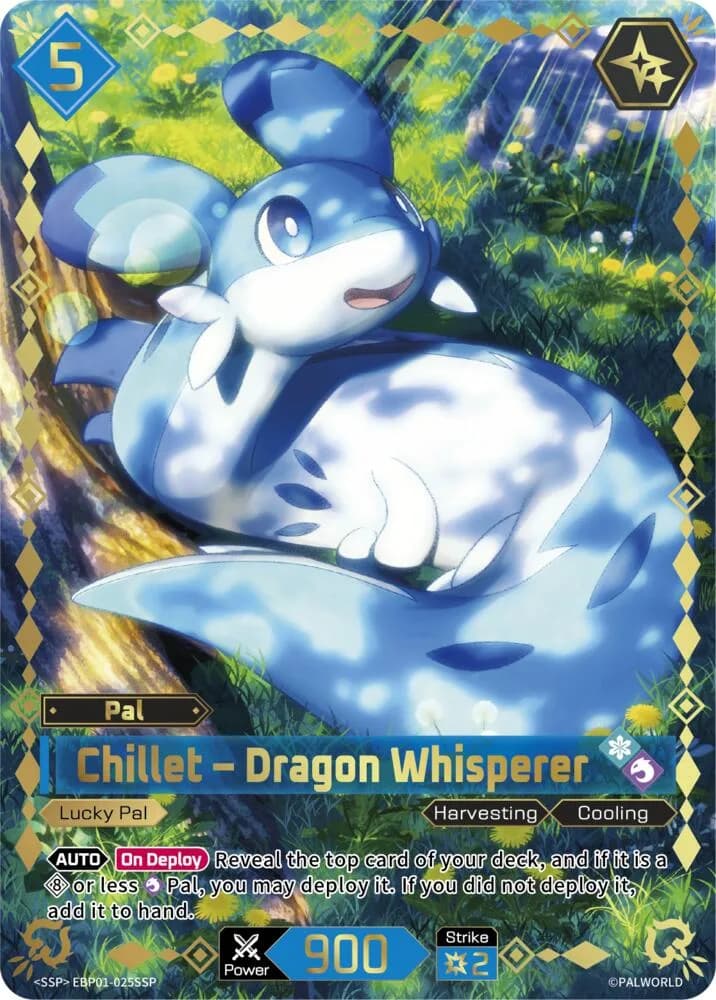
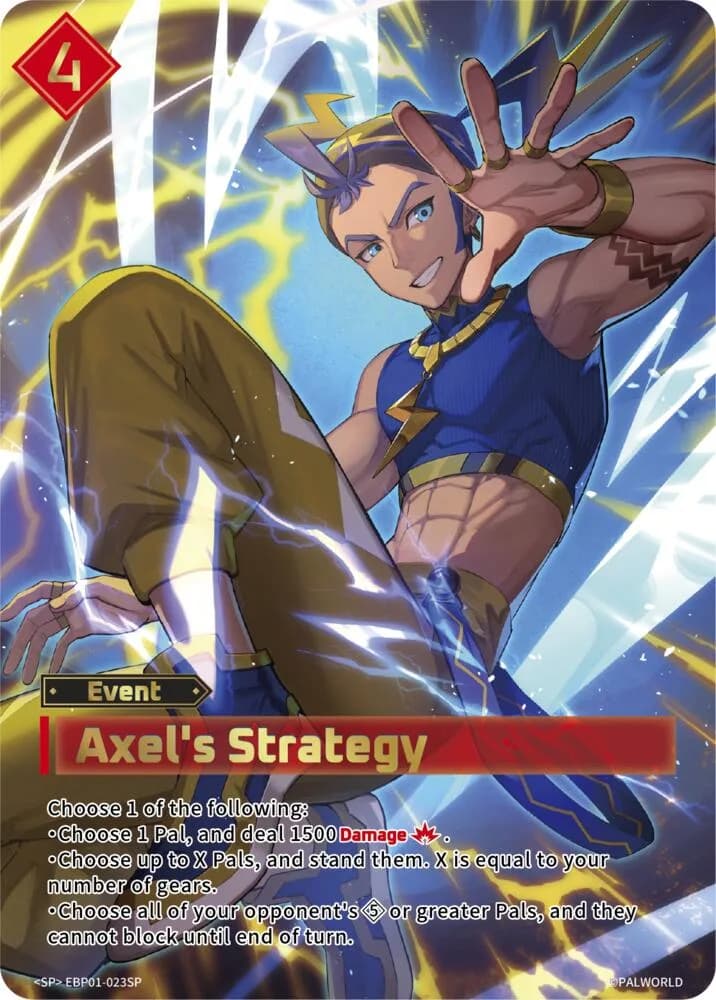
Pals lead the artwork, but they share the deck with gear, events and the base structures your Pals get assigned to. Here are three worth knowing.
This is the one thing worth learning first, because it changes what a finished collection looks like. A Palworld booster set has a base run of cards on plain numbers: Common, Uncommon, Rare and Double Rare. Most of those cards then appear again as a parallel, which keeps the same card number but adds a suffix and carries completely different art. SR and OSR are parallels. So are SP and SSP, at the top of the run. The publisher counts the base cards and the parallels separately, and that is the honest way to think about it: the checklist is a good deal longer than the headline card count, and marking off a base card leaves its parallels still open. HoloHoard lists every one of them as its own card, which is why your set completion tells you the truth.
The suffix on a Palworld card number tells you where it sits. A plain number is a base card; anything with letters after it is a parallel of that same card. Trial decks run a second ladder entirely, so a card marked TSR came from a deck and never from a pack. Souls are the resource cards, numbered on their own run, and one of them is a chase in its own right.
| Marking | What it is |
|---|---|
| No suffix | The base card: Common, Uncommon, Rare or Double Rare |
| SR | Super Rare, a parallel of a base card with new art |
| OSR | Over Super Rare, a step above Super Rare |
| SP | Super Parallel, the alternate art chases |
| SSP | Super Special Parallel, the top of the parallel run |
| TD, TSR, TSP | Trial deck cards, on a ladder of their own including its own parallel |
| SSS | Super Special Soul, a resource card treated as a chase |
| PR | Promo, from events and campaigns |
Decks are built in Red, Blue, Green and Purple, with Colorless cards that fit anywhere. Beyond the colour, Pals carry the traits the video game gave them: a Pal is either a Normal Pal or a Lucky Pal, it has an element that can be a pairing rather than a single type, and it lists the work it is suited to, from Kindling and Crafting to Farming and Transporting. Structures are the odd ones out and the easy ones to spot, because they are the only cards printed sideways. If you collect by colour, by element or by a favourite Pal, those are the details to sort on.
Every set has its own checklist page listing each card against every variant it comes in, and it is built from the live catalogue rather than typed up by hand. You can tick cards off as you go, print the whole thing to paper or PDF for a binder, or export it as an XLS or CSV to work with however you like. It is the quickest way to see what a complete Dawn of Palpagos actually looks like next to what is in your box.
Because the catalogue is already built, adding a card is a tap rather than a form. Collections hold what you own, with a count per card so duplicates are not a problem, and lists cover everything else: what you still want from a wave, what you are happy to trade at the next event, and what you are selling. As the collection grows the dashboard is what changes: set completion per wave, what you own against what exists, and where the gaps actually are.
HoloHoard puts a daily value estimate on cards with enough market activity behind them, and totals your collection from those. Cards that are too new or too quiet show as not valued yet rather than guessing, which matters on a line this young. You can see how a card has moved over time and keep an eye on your collection value as the sets land. See Palworld Official Card Game values.
Every Palworld Official Card Game set is catalogued on HoloHoard, including the trial decks and the promo cards. Parallels carry their own card numbers in this line rather than sharing a base card's, so each one appears as its own entry on the list exactly as it does on the card. You can browse any set for free without an account.
Yes. HoloHoard tracks Palworld Official Card Game collections for free, with the full catalogue already built in, so you mark the cards you own rather than entering them by hand. A free account covers collection tracking, wishlists and set completion; a Premium tier adds deeper value analytics and higher limits.
They are the suffixes on the card number, and they all mean the card is a parallel of a base card rather than a base card itself. SR is Super Rare and OSR is Over Super Rare; SP is Super Parallel and SSP is Super Special Parallel, the top of the run. TSR and TSP are the trial deck equivalents, and those come from a deck rather than a pack. A card with no suffix is the base version, so the full checklist is longer than the base card count.
Yes, and on this game that is exactly right, because the publisher gives each parallel its own card number rather than treating it as a finish on an existing card. HoloHoard lists them as separate cards, so owning the regular version does not quietly mark the parallel as collected and your set completion reflects what you actually have.
HoloHoard shows a daily value estimate for cards with enough market activity behind them and totals your collection from those. Cards without enough data show as not valued yet. Values are estimates blended from real market activity, not appraisals.
Yes. The HoloHoard app is a free download on Google Play for Android. It is the set checklist in your pocket: open a Palworld set, see which numbers you still need, and mark one off at a shop or a tournament rather than trusting your memory until you get home. Same account as the web, so the gaps update everywhere at once. Store links are on the HoloHoard app page.
Start your collection, free
No account needed to browse. Create one to track and value your cards.