Guide
Cyberpunk TCG launched with the most-funded trading card game campaign in Kickstarter history, and the cards that came out of it already have a clear top end. This page ranks the game's most valuable cards from the same daily value data the rest of HoloHoard runs on, so it reflects where the market is today rather than where it was when the page was written. Below the ranking you will find what each rarity is typically worth, why the backer run is the one with prices on it, and what changes when Welcome to Night City reaches hobby stores on November 6, 2026.
448 cards across 12 sets, catalogued and ready to track.
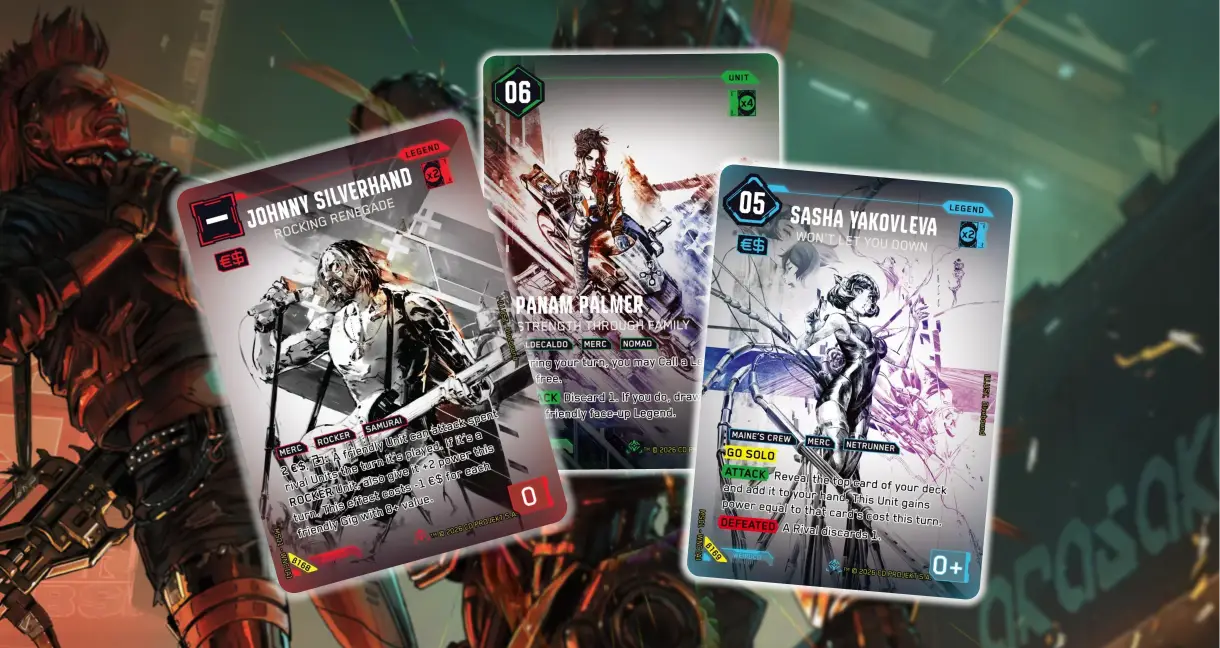
This list is built from current estimated values across every Cyberpunk TCG set we catalogue, refreshed daily. It is a live ranking, not a fixed list, so cards move between visits as the market moves. Values are estimates blended from real market activity rather than appraisals, and a card with only a little activity behind it is a thinner signal than one that trades often.
This ranking is generated from current values and updates daily: cards enter and leave it as the market moves, so it is never a fixed list. Last refreshed October 8, 2026. Estimates are blended from real market activity, not appraisals.
See every Cyberpunk TCG valueThe top of the table belongs to the Iconic cards, catalogued as Iconic Secret, Iconic Legend and Iconic Other. They are alternate artwork for cards that already exist at their own rarity, drawn from the Rare, Epic and Secret tiers, and they are the only cards in the game where singles reach into the hundreds. Foil is worth understanding alongside them: it tracks the rarity rather than being sold as a parallel, so Commons and Uncommons are standard cards and everything from Rare upward is foil. The second version of a card comes from the Iconic artwork, not from a foil treatment of something you already own.
A ranking tells you the ceiling. The rarity table tells you the shape of everything under it, which is what matters when you are opening product rather than buying a single card. Each row is the median of the priced cards in that rarity, with the typical range beside it, and each one states how many of its cards currently carry a value so you can see how solid the number is.
| Rarity | Typical value |
|---|---|
 Iconic Secret Iconic Secret | $826.39 ($674.99 to $973.23) |
| Iconic Legend | $81.79 ($62.08 to $245.28) |
| Iconic Other | $19.57 ($13.90 to $41.32) |
 Secret Secret | $15.75 ($13.22 to $27.63) |
 Epic Epic | $2.50 ($0.97 to $8.84) |
 Rare Rare | $0.29 ($0.16 to $0.48) |
 Uncommon Uncommon | $0.12 ($0.10 to $0.18) |
 Common Common | $0.11 ($0.09 to $0.14) |
Median of the priced cards in each rarity, with the typical range in brackets, built from the 172 of 172 cards in this set that currently carry a value. Estimates are blended from real market activity, not appraisals, and a rarity with only a few priced cards is a thinner signal than one with many.
Open the Cyberpunk TCG market pageSix Box Toppers were printed alongside the Kickstarter product, every one of them a Nova Rare and every one of them foil. Six cards is a small enough target that a complete run is a realistic goal rather than an ambition, which is part of why they hold interest: this is the one part of the line where you can see the whole thing and know exactly what finishing it takes. Read the Box Toppers guide.
Welcome to Night City exists twice, and telling the two apart in hand takes one glance: a Beta card carries a β immediately before its card number, and a retail card does not. HoloHoard catalogues them as separate sets card for card and mirrors that numbering, so what is printed on the card is what you find on the checklist. The Beta run is the one with a trading history behind it, because it is the one 50,773 backers have held since the campaign, which is why a ranking of the whole game currently reads as a ranking of Beta cards. That is not a judgement about which printing matters more, it is simply where the activity is today. Retail changes that: Welcome to Night City is scheduled to reach hobby stores on November 6, 2026, and that is the first time the retail printing meets an open market. Whether the backer run keeps a premium is a genuinely open question, and it is the kind of question a daily price history answers better than an opinion does. Both printings are already catalogued, so each builds its own record from its own first sale rather than being merged into one blurred line. Read the full Cyberpunk TCG collector's guide.
Every card here has its own page with a value history behind it, so you can see how it got to today's number rather than only what the number is. Add the cards you own to a collection and the same data totals up your holdings; add the ones you want to a list and you are watching the exact cards you care about. Both are free, the Cyberpunk catalogue is already built, and set completion tracks the Beta and retail runs separately. Open Cyberpunk TCG market data.
The top of the table is held by the Iconic Secret cards from Welcome to Night City (Beta), which are the shortest rarity in the set and the only Cyberpunk cards currently valued in the hundreds. The exact order changes as the market moves, so the ranking on this page is generated from current values and refreshed daily rather than written in.
Welcome to Night City was printed twice, and the quickest way to tell a copy apart is the card number: Beta cards carry a β immediately before it, retail cards do not. The Beta run is the one that has been in collectors' hands since the campaign, so it is the printing with a trading history behind it. The retail printing is scheduled for November 6, 2026 and starts building its own record from then. HoloHoard catalogues the two as separate sets, so each keeps its own values.
Iconic cards are alternate artwork for cards that already exist at their own rarity, catalogued in three tiers: Iconic Secret, Iconic Legend and Iconic Other. They are drawn from the Rare, Epic and Secret tiers rather than from Commons and Uncommons, they are all foil, and they sit at the top of the game's value table. Secret remains the top regular rarity.
Individually they are the cheapest part of the set, typically well under a dollar, and they are standard rather than foil. They matter for set completion rather than for value, which is where a checklist is more useful than a price: marking off what you have shows you the handful of cards actually standing between you and a complete run.
Daily. The ranking and the rarity table on this page both read the same value data as the rest of HoloHoard, and each card page carries a price history so you can see how a value has moved rather than only where it stands today.
Start your collection, free
No account needed to browse. Create one to track and value your cards.