Guide
Every collector knows the problem. You pull a low-numbered parallel or pick up a card from a brand-new set, go to check the comps, and there are none. Rare cards can go months between sales, and a new release has no history at all. For those cards HoloHoard shows an Expected value range: what the closest comparable cards are selling for, so buyers and sellers both have a fair number to work from.
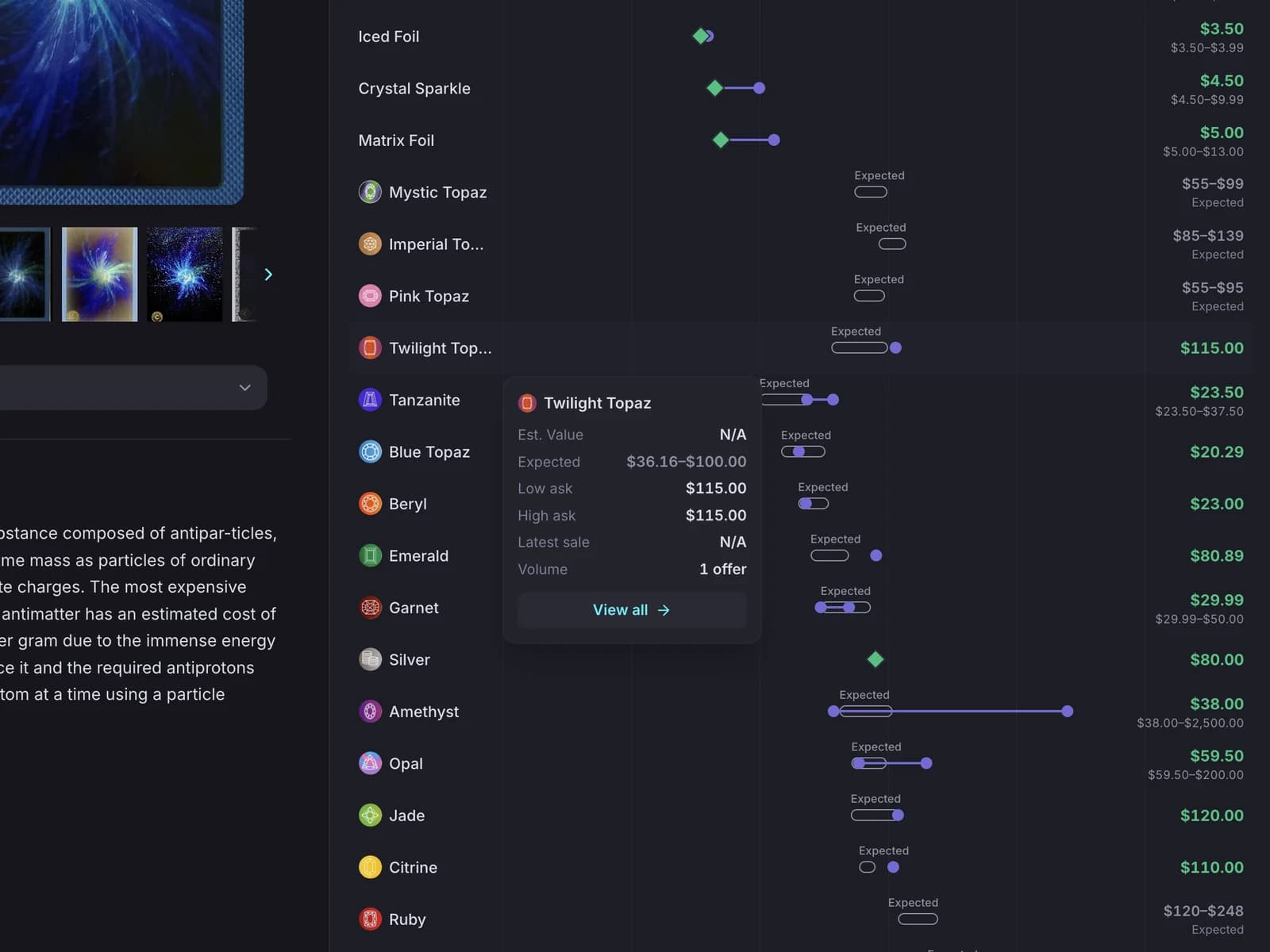
Est. Value, the number on most card pages, comes from real sales of that exact card and variant, cleaned of outliers and updated daily. When a card has no sales of its own, the honest move is the one experienced collectors already make: comp the closest thing that has sold. The Expected value range does that for you, with the same discipline every time. How Est. Value is calculated.
The range is the middle half of comparable cards: a quarter of them sit below it and a quarter above it, with the median marked on the bar. The line underneath says how many cards it rests on, because a range built from forty cards means more than one built from four. It is labelled Estimate and drawn in neutral colours on purpose, so it never reads as this card's own value. The moment the card itself sells enough to earn an Est. Value, the range disappears and the value takes its place.
The first choice is the same variant in the same set. A /25 parallel that has not sold yet is comped against the other /25 cards from that set that have. When a set is too new for anything in it to have sold, the comparison moves back to the previous set in the same line, where the same parallel already has a track record. Two rules keep the comps clean. Only cards valued from real sales count, never cards priced from listings alone. And serial numbered cards only compare with the same print run, so a /49 is never comped against a /25. If a variant has no fair comparison, such as a brand-new insert with nothing like it in the earlier set, HoloHoard leaves the range off rather than guess.
Take a line that releases a new set with the same parallels and print runs as the last one. On release day nothing in the new set has sold, but every parallel has a counterpart in the previous set that has. So each new card page opens with the range its counterpart sold in. Here is how that looked for Cardsmiths Currency Series 6, comped against Series 5 at the end of September 2026. The live ranges move with the market, and each new card switches to its own Est. Value once its own sales come in. The Series 6 guide.
| Variant | Comparable cards | Expected value range |
|---|---|---|
| Base | 71 | $0.99 to $2.12 |
| Rainbow Holofoil | 72 | $3.00 to $4.00 |
| Beryl /149 | 49 | $20.00 to $37.00 |
| Emerald /99 | 42 | $25.00 to $50.00 |
| Ruby /25 | 14 | $142.49 to $248.75 |
| Gold /10 | 8 | $327.53 to $500.00 |
| Snowflake Refractor /3 | 7 | $337.50 to $399.98 |
It is not a price, an appraisal or an offer. It is built from raw, English-language copies, so it is a reference for a raw copy, not a graded one. It never counts toward your collection, list or dashboard totals; those use real Est. Values only. And it needs enough comps to be fair, so a true 1 of 1, which has nothing to compare with, will not show one.
Every Expected value range links to the comparable cards it is built from. With Premium you can open the actual sales behind it, each with a link to the listing, and see the spread for yourself before you buy or list. Free accounts see the range and the pool size, which is enough to know whether an asking price is in the right neighbourhood. See what Premium includes.
Compare it with the closest cards that have sold: the same variant and print run, in the same set or the one before it. HoloHoard does this automatically and shows the result as an Expected value range on the card page, built from real sales only.
Most parallels do. If the line's previous set has the same parallel and print run, the new card shows that counterpart's Expected value range from day one, then switches to its own Est. Value once its own copies sell.
A range only appears when enough comparable cards are priced from real sales and, for serialised variants, when the print run matches. A 1 of 1 or a brand-new insert has nothing fair to compare with, so HoloHoard leaves the range off rather than guess.
No. Collection, list and dashboard totals only ever use real Est. Values. The range is a reference on the card page and nowhere else.
Start your collection, free
No account needed to browse. Create one to track and value your cards.